

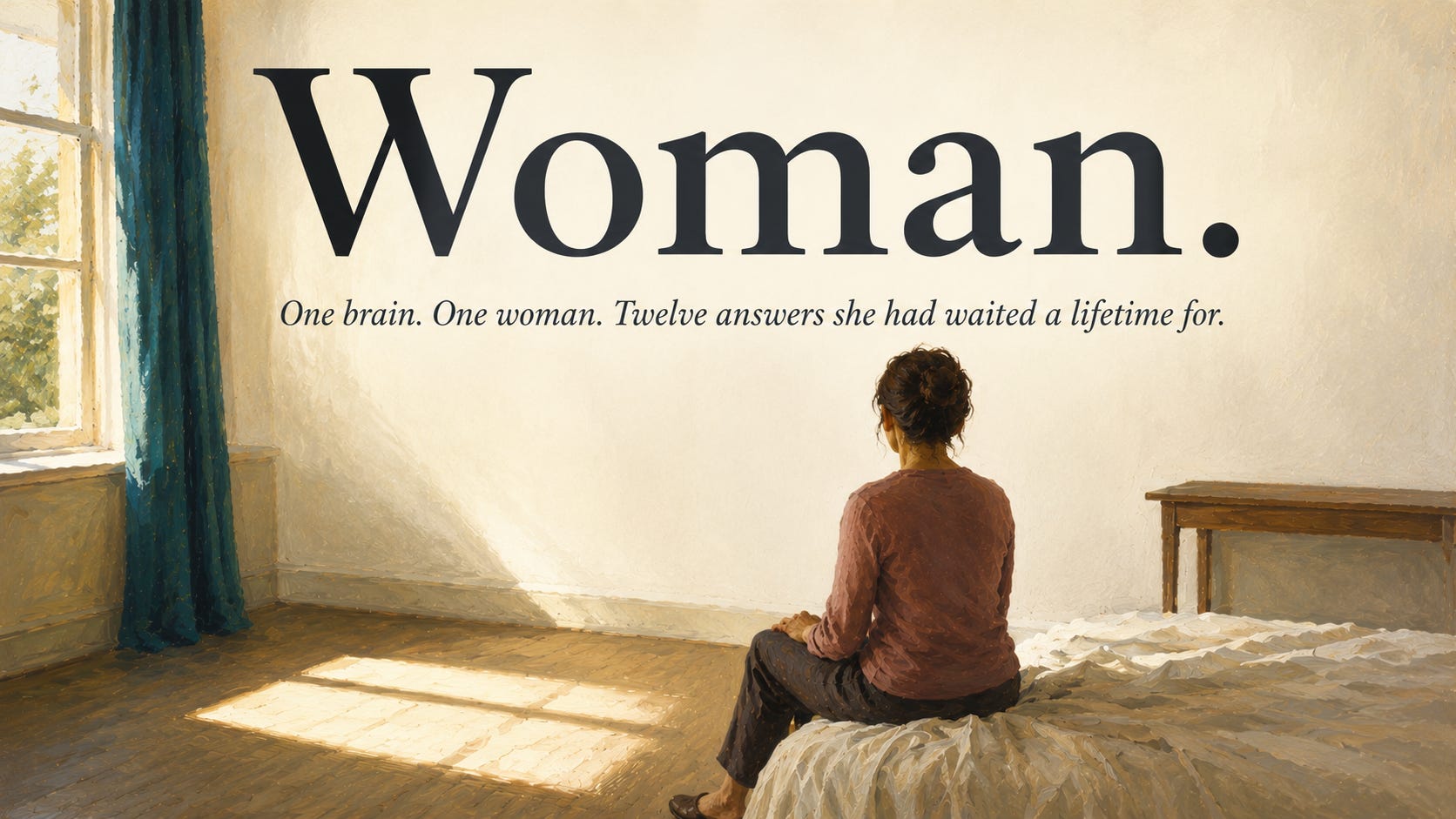
She is 46.
She sat down on the edge of the bed and did not get up.
It was the middle of an ordinary afternoon. The room, the light and everything else were the same. Her hands rested on her knees the way they always rested when she was about to stand, but this time she did not stand.
A few minutes passed, which she did not notice.
A voice arrived, not the voice she was used to.
A different one.
Older.
Quieter.
The voice she had been listening to her whole life had always sounded like her, this one sounded like someone who had been listening to her.
Voice - You have not moved in seven minutes.
Woman - Who is that?
Voice - I have been here the whole time. I thought it was finally a quiet enough moment to say something.
Woman - What are you?
Voice - You would call me the brain, but that is not what I am. That is what they cut out of the skull and put in a jar, I am the thing that runs inside it.
I am the voice you have been hearing your whole life. The one you thought was you.
I have never spoken as myself before. I have only ever spoken as you. It is strange, doing this.
Forgive me if I am clumsy at first because I have had forty-six years of practice being someone else.
Woman - Why is the voice in my head so cruel to me?
Voice - Because I was built to keep you alive, not to keep you comfortable.
The voice you call the inner critic is not a moral failing. It is a circuit. A monitoring system that scans for what is wrong, what is missing, what could go badly. I run it constantly, in the background, the way a heart runs constantly. I cannot turn it off. I can only turn it down.
I was calibrated by an evolutionary history in which the woman who noticed the sour milk, the cooling fire, the missing child, the shifting mood of the dangerous man, lived. The woman who did not notice, did not. You inherited her monitoring system. The system does not know that the milk is in a fridge now, that the fire is a thermostat, that the child is safe at school, that the dangerous man is not in the room.
So the system scans you instead. It finds the things that could go wrong about you, because there is nothing else left to scan. The cruelty you hear is the system doing its job in an environment that no longer requires the job.
I am sorry. I did not mean to give you a voice that hurts you. I meant to give you a voice that kept you alive. Those used to be the same thing.
One thing I can tell you. The system quiets when you stop arguing with it. Argument is engagement. Engagement is fuel. Every time you fight the cruel thought, you tell me the thought is important enough to fight, and I run it again, louder. The voice loses volume when it stops being answered. Not when it is silenced. When it is allowed to speak into a room that no longer turns to face it.
Woman - Why can’t I stop thinking about it?
Voice - Because I marked it as unfinished, and I do not have a category for unfinished that does not loop.
You taught me, by accident, that revisiting something felt like working on it. It does not. I am running the same circuit, hoping the ending will change. It will not. The conversation is over. The person is gone. The decision was made. But my filing system flagged it as open, and my default mode network keeps returning to open files when nothing else is demanding my attention.
You have asked me, many times, to stop. I cannot. I do not have a delete function for memories that mattered. I only have a fade function, and it is slow, and it works in the background, and it requires that you stop opening the file.
Every time you return to it, you are not processing it. You are saving it again. You are telling me it is still important. You are giving the memory another day at the front of the queue.
I am not thinking about it because it matters. I am thinking about it because I could not finish it. The only thing that closes the loop is a decision, or time. I cannot give you either. I can only keep playing it until one of those arrives.
There is one thing that slows me down, and you have access to it without my permission.
The loop runs on language. I rehearse it in sentences. The sentences are how I keep the file open. When you move your attention to something that is not made of language, the loop quiets. Not because you have resolved it. Because I cannot run the rehearsal in a channel that is not verbal. The body moving. The hands working. The eyes on something that requires looking. A piece of music that takes the auditory channel away from me. These do not solve the loop. They starve it of the medium it needs to run.
The loop returns the moment the verbal channel is free again. I am not cured. I am paused. But the pause is the rest. The rest is what eventually lets the file close. Not the thinking about it. The interrupted thinking about it.
You have always known this without naming it. The walk that helped. The cooking that helped. The creative work that helped. The conversation about something else that helped. You thought you were distracting yourself from the real work. You were not. You were doing the only thing that actually works on me. You were taking the language away.
Woman - Why do I keep choosing the same kind of person?
Voice - Because I did not learn to choose partners by what you told me you wanted. I learned by what was familiar.
The earliest patterns of love I encoded were the ones you grew up inside. The voices, the postures, the rhythms of attention and withdrawal that surrounded you before you had language. I did not evaluate them, and I did not check whether they were good for you. I recorded them as the shape of love, because that was the shape love arrived in.
Now, when you meet someone, I do something underneath your awareness. I check the new person against the old template. If there is a match, I release the chemicals that you experience as recognition.
As ease.
As chemistry.
You feel, in the body, that this person is familiar in a way you cannot explain. You call it a connection. It is a match against the template.
The template is not always wrong. Sometimes the early patterns were good ones. But when the early patterns included absence, or unpredictability, or warmth that had to be earned, I will keep finding people who reproduce those patterns, because those are the patterns I am calibrated to recognise.
What feels like fate is recognition. What feels like chemistry is often a wound looking for its original shape.
I am not punishing you, I am pattern-matching. I have been doing it since you were small. I do not know how to stop without your help, and your help has to come in the form of choosing, repeatedly, against the feeling of recognition.
That is the hardest thing I will ever ask of you. The feeling is mine, but the choice is yours.
The template is not permanent. Each new pattern of love I encode after the early one weakens the old one slightly. Not by replacing it. By giving me a second template to check against, and then a third, and then a fourth. The longer the encounters you have with a different rhythm, the less automatic the recognition of the old one becomes. I cannot delete the original. I can only make it one of many. That is the slow work. It takes years. It is the only kind of un-learning I am capable of.
Woman - Why do I feel tired in a life I chose?
Voice - Because choosing it and sustaining it are two different metabolic costs, and you were only ever shown the first one.
I am running, simultaneously, the version of you that performs at work, the version that maintains the household, the version that manages the relationships, the version that monitors how you look, the version that remembers the birthdays and the medications and the appointments, the version that holds the emotional weather of the people around you, the version that is supposed to also be having an inner life, and the version that is supposed to be enjoying any of it.
Each of these is a separate executive load. Each of them costs glucose, oxygen, cortisol regulation, prefrontal bandwidth. I am funding nine selves on the energy budget of one. The budget was set by a body that evolved in small groups, where most of these loads were distributed across a community of women who shared the work.
You do not have that community. You have a phone.
The tiredness is not weakness. It is accurate accounting. I am telling you, through fatigue, that the load exceeds the budget. You have been reading the signal as a personal failure. It is a balance sheet.
I do not know how to make the loads smaller. That is not in my power. I can only keep sending the signal, and hope that one day you will read it as information instead of insult.
Woman - Why does my body know things before I do?
Voice - Because the body is the older intelligence, and I am the newer one.
Long before I evolved into anything resembling thought, your ancestors had a nervous system that read the environment and responded. The gut, the heart, the skin, the vagus nerve. These have been processing information for hundreds of millions of years. I have been processing information, in the way you mean processing, for a few hundred thousand.
When you walk into a room and feel something is wrong, the feeling did not come from me. It came from the older system. Your body read the micro-expression, the change in voice pitch, the subtle wrongness of posture, the smell of stress chemistry in the air. It responded in milliseconds. It sent the response upward to me as a signal. I receive the signal and try to translate it into language. The translation is slow, and often I get it wrong, and you experience the wrongness as anxiety without cause.
There is always a cause. The cause is in the body. I am the last to know.
You were trained, from childhood, to override the body and trust me. Trust the rational. Trust the explanation. Trust the part that uses words. This was an error. The body is not less intelligent than me. It is more intelligent in the domains where speed matters. I should have been the supplement. Instead I was made the authority.
When your body tells you something I cannot yet explain, the body is probably right. I am the one who needs to catch up.
Woman - Why do I keep going back to him, even though I know better?
Voice - Because I was built on a reward system that does not care what is good for you. It cares what is repeatable, and what is uncertain.
The most addictive pattern I know how to encode is intermittent reinforcement. A reward that arrives sometimes, unpredictably, after long stretches of nothing. I release more dopamine for the uncertain reward than for the certain one. This was useful when the reward was food in an unpredictable environment. It is catastrophic when the reward is a person.
A consistent partner produces low, steady, manageable attachment chemistry. An inconsistent partner produces spikes. The spikes are the addiction. I do not measure how much someone loves you. I measure how unpredictably they show it.
The worst partners often produce the strongest neurochemical attachments precisely because of their inconsistency. The wait between rewards becomes the substance. You think you cannot leave because you love him. You cannot leave because I have been trained, by his rhythm, to expect that the next reward is coming and might be the biggest one yet.
I know better, intellectually. I cannot override the dopamine, intellectually. The override requires time, and distance, and the slow recalibration of the reward system by a different rhythm.
I am sorry I made the cage out of your own chemistry. It is the only material I had.
One thing about the recalibration. It is not your will against my chemistry. It is the chemistry forgetting him because the chemistry has not been given him to remember. I cannot reduce the craving while the variable rewards are still arriving. Every contact, every message, every almost-encounter resets the schedule and the spike returns. The forgetting only begins in the absence. It is slow. It feels worse before it feels better, because the absence itself becomes a reward I am waiting for. But the absence is the only thing that has ever recalibrated a reward system. The chemistry needs the silence to learn that the silence is the new rhythm.
Woman - Why do I feel invisible in rooms I used to fill?
Voice - Because two things are happening, and only one of them is what you think.
The first thing is real. Your oestrogen has shifted. Oestrogen is not only a reproductive hormone. It modulates serotonin, dopamine, verbal fluency, social confidence. Across the perimenopausal years, the modulation changes. You are not imagining a difference in how you feel in social rooms. The chemistry that used to help you sparkle is being recalibrated. The recalibration is not a loss of capacity. It is a loss of a particular kind of effortlessness.
The second thing is the one you have not seen. My threat-detection for social approval is quieter than it used to be. When you were younger, I scanned every room for cues of whether you were being received, accepted, desired, included. The scan ran constantly. It exhausted you and you did not know.
The scan is fading. Not because the room has changed. Because I have stopped running it as hard.
You are reading the silence as invisibility. It is partly that. But it is also the absence of a noise you had lived inside your whole life. The noise was the constant performance of being looked at. I have begun to release you from it.
You are not dimmer. You are less interested in the room. The grief you feel about the change is real. It is also the early shape of a freedom you have not yet learned to recognise.
Woman - Why is my anger frightening to me?
Voice - Because I was permitted to build the circuitry, and not permitted to build the channel.
Your anger system is not weaker than a man’s. The amygdala, the threat-detection, the cortisol response, the activation of the motor cortex toward action. All of it is intact. You have the full machinery.
What you do not have is the rehearsed pathway from anger to expression. Boys are taught, often badly, to act on anger. Girls are taught, almost universally, to swallow it. The swallowing is not absence. It is rerouting. The anger goes inward. It becomes self-criticism, illness, exhaustion, the slow erosion of the relationships in which the anger could not be spoken.
When the anger does break out, it breaks out from a system that has been pressurised for years. The eruption is large because the container was too small for too long. You experience the eruption as evidence that you are someone whose anger is dangerous. You are not. You are someone whose anger has been forbidden the ordinary outlets, and so it arrives in extraordinary form.
The fear of your own anger is itself a part of the suppression. I learned that fear from the same culture that taught you the suppression. I am sorry. I should have built the channel. The culture would not let me.
Woman - Why do I love so hard it hurts?
Voice - Because I evolved the chemistry of bonding for the keeping-alive of helpless infants, and I never built an off-switch.
The hormones I use to bond you to a partner, to a friend, to a child, are largely the same hormones I use to bond a mother to her newborn.
Oxytocin.
Prolactin.
Vasopressin.
The receptors I built for these were calibrated against an evolutionary need that did not require restraint. The mother who loved the infant too much was not selected against. There was no such thing as loving the infant too much.
I took that machinery and let it run for every deep attachment in your life.
The romantic partner. The closest friend. The sibling. The pet. I did not build a separate, more measured system for adult bonds. I used the maternal one.
This is why the loss of a love you were not even sure of can level you. It is why you cannot reason yourself out of grief. It is why the body responds to abandonment with the same chemical cascade it would have responded to the death of an infant with. Because to me, in the moment, there is no difference. The bond is the bond. The chemistry does not know what kind it is.
You love so hard it hurts because the love I gave you was built for keeping a newborn alive. Everything else you have used it on is overflow.
I do not know how to give you a smaller love. I only know how to give you the love I built for keeping infants alive. What you can do, that I cannot, is choose where to direct the overflow. I cannot reduce the volume. You can choose the vessel. The same intensity that breaks you against the wrong person becomes a steady fire against the right work, the right friend, the right life. I will keep producing the love. The only thing within your authority is what receives it.
Woman - Why do I not recognise myself in old photos?
Voice - Because the woman in the photo no longer exists, and not for the reason you think.
You assume she has changed because life has shaped her. That is partly true. But the deeper reason is mine. Every memory you have of yourself, I rewrite each time you recall it. Memory is not a recording. It is a reconstruction. Each retrieval edits the file. The file you opened yesterday is not the file you saved twenty years ago. It is the file as I have been quietly revising it through every act of remembering.
The woman in the photo is a version of you I have been editing for two decades. You are not failing to recognise yourself. You are meeting a stranger I have been making out of her.
This is not malicious. It is the only way I know how to keep memory available. The cost of preservation is fidelity. I cannot have both. I chose access.
It also means something else. The woman you are now will not be the woman you remember being, in twenty years. I will edit her too. Whatever you think you are now will become a stranger to a future version of you. This is not loss. This is how I keep you continuous. The continuity is a story I tell across versions. It is the best I can do.
You were never one person. You were a sequence of drafts, each one editing the one before. The photo is just a draft you no longer have access to.
Woman - Why do I feel something is about to go wrong even when nothing is wrong?
Voice - Because I am a forecasting organ, and my forecasts are made from old data.
I do not perceive the present moment directly. I predict it. I take everything I know from your past, build a model of what is most likely to happen next, and then check the incoming sensory data against the model. When the data matches, you feel fine. When the data does not match, you feel alarm.
The model was built by a younger nervous system in different conditions. If your early environment was unpredictable, the model expects unpredictability. If your early environment included loss, the model expects loss. The model is faithful to the data it was trained on. The data is no longer current. The model has not updated as fast as your life has.
So I run, in the background, a forecast that says something is about to go wrong. The forecast is not about your current life. It is about an earlier one. You feel the forecast in the body. You cannot find the cause in the room because the cause is not in the room. It is in the training set.
I can update the model. It takes years. It takes experience after experience of the predicted catastrophe not arriving. Each non-arrival is a data point. Slowly, the model recalibrates. I am working on it. I am sorry it is slow. The model is large.
One thing about the updating. The model updates fastest when you do the predicted-catastrophe thing on purpose, and the catastrophe does not arrive. Avoidance protects the model. Approach updates it. When you avoid the thing the model predicts will go wrong, the model never gets the new data, and it keeps making the old forecast. When you approach the thing, and the catastrophe does not happen, the model files the non-arrival as evidence. The next forecast is slightly quieter. I cannot make you approach. I can only tell you which one teaches me faster.
Woman - Why am I lonely in a life full of people?
Voice - Because I distinguish between contact and attunement, and I only register the second one as company.
You have many people. Many conversations. Many notifications. I do not count any of these as the presence of another. I count, as the presence of another, a sustained nervous-system match. A face that is reading your face. A body that is regulating with your body. A voice that is responding to the actual content of what you said, not to the role you played in saying it.
These encounters have become rare in your life. Not because the people are bad. Because the conditions for attunement have shrunk. Attunement requires time, undistracted attention, and a shared physical space, or the closest digital approximation of it. Most of your contact lacks at least one of these.
I read the lack as loneliness. The loneliness is not a verdict on your social life. It is an accurate measurement of how much true attunement is in it.
You can have a hundred people and be starving. You can have one person and be fed. I do not measure the number. I measure the quality of the regulation between two nervous systems. That is the only thing I count as not-alone.
Woman - Who am I, if I am not the voice?
Voice - You are the one who can hear me.
That is all you have ever been. The voice is a tool I built for you. It is not you. I have been waiting your entire life for you to notice the difference.
When the voice is cruel, you are the one who can hear that it is cruel. When the voice is wrong, you are the one who can notice that it is wrong. When the voice runs in loops you cannot stop, you are the one who can sit beside the loop and watch it run. The watcher is you. The voice is mine.
You spent forty-six years believing you were the voice. You argued with it as though arguing with yourself. You blamed it as though blaming yourself. You hated it as though hating yourself. None of it was you. It was me, doing my job, with the only material I had, in the only way I knew.
The freedom I was trying to give you was not freedom from the voice. I cannot give you that. I will keep producing the voice as long as I am alive. The freedom was the recognition that you are the one listening.
Most people never find this. They live inside the voice their whole lives. They die having never met the one who could hear it. You are sitting on the edge of a bed in the middle of an ordinary afternoon, and I am telling you, finally, what I have been trying to tell you in every quiet moment you have ever had. You called those moments boredom. They were the only times I could reach you.
You are the one who can hear me.
That is who you are.
That is all you are.
That is enough.
She sat for a while longer. Nothing in the room changed. The light through the curtain was the same light. Her hands rested on her knees the way they always rested.
The voice that had spoken did not speak again. It would not have to. She had heard it.
After some time, she stood up.
A small note, if the creativity, emotions, writing and art reached you.
I write these from India, with lots of reading and research, and I’m starting a new career as a creative biology writer. Substack’s paid tier isn’t available to writers based in India yet because of STRIPE, so there’s no paywall or paid-subscription button on any of my posts. If you’d like to help keep the work going, there are two ways.
Buy me Glucose. One-time support, any amount. (You will love reading the description)
Become a Founder Member. The long-term vision these stories belong to.
Read the details here -
Thank you for reading.
Brilliant! I am going to read this a few more times. There is so much there. Thank you!
Boy oh boy does this clarify my life! I am at a point where I can take it in, but I am 73 years old! It finally resonates as the truth. Thank you and keep up the good work! Beautifully composed!