

A note before you begin.
Every piece here starts the same way. Weeks of reading the actual papers, not the summaries. Then the slower work, turning real mechanisms into a story you can feel, without bending a single fact to make it land. Scientific accuracy is the one line that does not get crossed, even when a looser version would read faster and easier.
That work takes time, and time is the one thing reader support buys back, and The Biological Imagination needs support.
If this piece earns it, there are three ways to keep it going. You can become a paid subscriber. You can buy me a coffee, if a one time thank you suits you better. Or you can become a founder member and back the longer vision all of this is building toward. The details are waiting at the end of the article.
Either way, thank you for reading. That part matters most.
The prophet who is never wrong
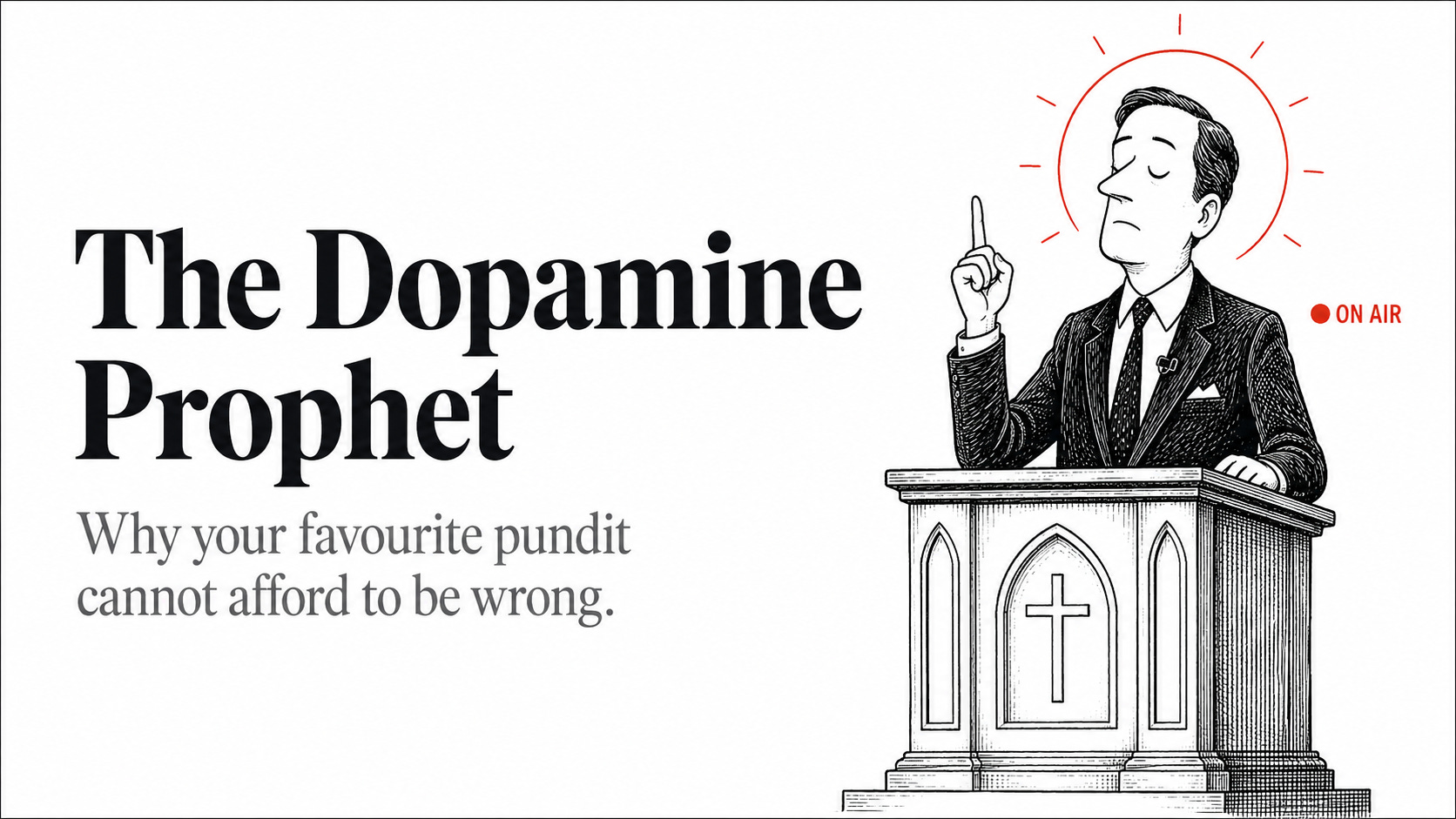
Your favourite face is on the screen, the confident one. Last month it told you exactly what was going to happen, the election, the market, the match, the verdict, and it was certain about all of it. Then it was wrong, not in some small forgivable way but in a way that should have ended the conversation. This month the same face is back in the same chair, with the same certainty and the same audience, and the miss is never once mentioned. And somehow you are still watching. (And you will keep watching if you don’t understand the mechanism)
In 1948 an American newspaper was so sure of the result that it printed the headline before the votes were counted, and the headline said Dewey defeats Truman. Truman won. The photograph of the grinning winner holding up that wrong front page has outlived every prediction it ever ran.
But do not let yourself off the hook by calling it history. In the summer of 2022 one of the most respected business magazines in the world put a young man on its cover and asked whether he was the next Warren Buffett, at a moment when his crypto company was valued at thirty two billion dollars. Within months that company was worth essentially nothing and he had been convicted of fraud. The magazine had hedged, in fairness, with a single phrase, build an empire or crash and burn, and we found out which. But the hedge is not the part anyone remembers. The cover said genius. (This word has been used many times by the magazines, and I hope they internally regret when they are proven wrong)
I call these people, these experts, these magazines with a very interesting name - The Dopamine Prophets.
These are not isolated mistakes, they are symptoms of a system that pays for confidence far more reliably than it pays for accuracy. To understand why, you have to look away from the screen and down at a single molecule, and it is not the one you have been told about.
The molecule you misunderstand
The molecule is dopamine, and you have heard about it a thousand times. It is the pleasure chemical, the reward molecule, the thing that supposedly fires when you eat the cake, win the game, or collect the like. It is a tidy story, it is everywhere, and it is almost entirely wrong.
Start with something you almost certainly did this week. You picked up your phone to check one thing, and twenty minutes later you were still scrolling without enjoying any of it, not even really reading, just feeling a low pull to keep going and a faint emptiness the whole time. If dopamine were pleasure, that should have felt good. It did not. So what was it doing?
A scientist named Kent Berridge spent decades on exactly this gap, pulling apart two things we usually fold into a single word. Wanting is the pull toward a thing. Liking is the pleasure of actually having it. We assume the two always travel together, and they do not.
In one of the cleanest experiments on this, Wyvell and Berridge, in 2000, flooded a rat’s dopamine system with a stimulant, and the rat promptly worked much harder for sugar, clearly wanting it more. Yet when they watched its face for the actual pleasure reactions to the taste, nothing had changed at all. The wanting had climbed. The liking had not moved.
That is your phone. It is the slot machine that keeps a body in the seat long after the fun has gone, and the junk food eaten without ever being tasted. Dopamine is the wanting. The pleasure, the actual liking, lives somewhere else entirely, in small systems that have little to do with it, which is why more dopamine never buys you more pleasure. It only buys more pull. That is the first crack in the story.
Now the deeper one, and it comes from a monkey.
In 1997 Wolfram Schultz, working with Peter Dayan and Read Montague, slipped tiny electrodes next to the dopamine neurons of monkeys and gave the animals sips of juice, expecting the cells to celebrate the reward. They did something far stranger. They did not fire for the juice at all. They fired for the surprise.
Think about the last time you put on an old coat and found money in the pocket. The small lift you felt was never really about the money, it was about the money you had not expected. Now think about your salary arriving on the day it always arrives, the same amount, fully predicted, and notice that it produces no lift at all. Then think about the vending machine that swallows your coins and gives back nothing. That little drop in the chest, that flash of being cheated, is the third thing.
Those are the three signals Schultz found, exactly. When the outcome beats expectation the neuron fires harder, when it merely matches expectation the neuron does nothing, and when it falls short the neuron goes quiet. The juice was never the point. The point was the gap between what you predicted and what arrived.
It is worth being precise here, because the detail is the whole argument. Many of these neurons tick along slowly at rest, only a few times a second, and a genuine surprise can drive that rate up into a brief burst, while a reward you were counting on, and do not get, pushes it the other way, below its resting pace. So the same cell carries both a reward and a punishment, a lift for being pleasantly surprised and a dip for being wrong.
In the monkey, the signal does not stay put on the juice. Once the animal learns the sound that reliably comes just before the juice, the spike migrates backward onto the sound itself, and the juice, now fully expected, goes quiet.
You already know this migration. The streaming app’s start-up sound before the show, the two grey ticks turning blue, the little notification ping, none of these is the reward itself. They are only the signals that a reward is coming, and your brain has quietly shifted its excitement onto the signal, which is exactly why the ping pulls harder than whatever sits behind it. Dopamine is not a receipt for pleasure. It is a teaching signal about prediction.
So two completely different labs, working in two completely different ways, arrive at the same place. Berridge shows that dopamine is wanting rather than pleasure, and Schultz shows that it is prediction rather than reward. The rule underneath both is simple enough to hold in one hand. Dopamine tracks the gap, lifting when reality beats your forecast and falling when reality comes in worse.
The asymmetry
Before we go back to the screen, sit with the fall, because it does most of the work. (It is painful but truth)
Being right, it turns out, is not much of a high. A reward you fully predicted produces a flat signal, so if you called it perfectly the molecule simply shrugs, and the real lift stays reserved for being right in a way that still manages to surprise you. Mere accuracy is quiet.
But being wrong is loud. When the thing you were certain of fails to arrive, the brain does not simply settle back to neutral, it drops below its own resting level. You have felt this. (It is sometimes similar to physical pain).
It is the certainty in your chest as your team is about to win and the floor falling away when they lose, the argument you know you are winning and the small sickness when it turns out you were not.
That dip is real, and the brain hates it. It will spend real effort to keep the dip away, even, as we are about to see, at the cost of the truth.
Consider the record. A magazine crowned its next Warren Buffett, and he was convicted. A front page announced a winner before the votes were in. A recession was called certain and never arrived. A self-driving car was promised for one year, then the next, then the next. And a room of the world’s best economists, asked by a Queen in 2008 why none of them had seen the crash coming, had no good answer to give her.
The question underneath all of it -
Why don’t these mistakes end careers?
Back to the prophet
For about twenty years a researcher named Philip Tetlock did the one thing the industry never does, which is keep score. He asked nearly three hundred experts to attach real numbers to real events, then waited, sometimes for years, and checked what actually happened, ending up with around twenty eight thousand predictions graded against reality.
The results, published in 2005, were brutal, and Tetlock’s own summary of them became famous. Across the field, he said, the average expert did little better than chance, about as accurate, in his phrase, as a dart throwing chimpanzee, and no better than a reasonably attentive person who simply read the news. The knowledge was real. The forecasting was not. (It is scary)
Then comes the finding that should change how you watch anything at all. The more famous the expert, the worse the forecast, with fame and accuracy running in plainly opposite directions, and the reason is almost mechanical. Fame rewards confidence and a single bold story, while accuracy rewards doubt and a hundred small corrections, and the booker always wants the guest who sounds certain rather than the one who keeps saying that it depends. So the market quietly selects for the very trait that ruins forecasting, which means that, on average, the louder the voice the worse the call.
When the predictions failed, the experts almost never revised their picture of the world. Instead they reached, again and again, for the same small set of excuses. I was off on the timing. I was blindsided by a freak event. I was almost right. I was wrong, but for the right reasons. You have heard every one of these, probably this week.
Watch how cleanly a real example fits the list. In late 2022 forecasters were nearly unanimous that a downturn was on the way, and one closely watched model, from Bloomberg Economics, put the odds of a recession within the year at one hundred percent. Then 2023 arrived and the economy grew. The forecast was not wrong, they explained, it was merely early, and so they moved it to 2024, which is the timing excuse playing out in real time. The car that was going to drive itself by 2017 will, apparently, drive itself next year. Each missed date does not retire the prediction. It renews it.
Now look at what every one of these excuses actually does. It saves the prediction, and it refuses the dip.
Because admitting you were wrong means taking the fall, that same drop below baseline we watched in the monkey and that you felt the moment your team lost. Reinterpreting the evidence so that you were never really wrong is what keeps the fall away. The doubling down, then, is not stupidity and not quite dishonesty, it is loss avoidance, because the molecule does not want the truth so much as it wants to dodge the dip, and given the choice between updating its view and editing reality, it edits reality.
Tetlock measured the editing. Schultz, decades earlier, measured the reason for it.
So say it plainly. The prophet does not need to be right. The prophet needs to not feel wrong. Those are different jobs, and only one of them pays.
And watch what happens when the miss is simply too big to wave away with a small excuse. The avoidance does not stop, it escalates. The prophet who cannot afford the dip will first deny the facts, then attack the people who wrote them down, and finally call the whole correction a conspiracy against them, growing louder and more certain rather than quieter, because the bigger the bet made in public, the bigger the fall waiting if they ever concede. The defense grows to the exact size of the dip it is holding back.
The fear may run deeper than a bruised ego. For most of human history, status was not a luxury. It was access to allies, resources, protection, and mates. A public loss of standing could carry real costs. The modern pundit may be operating inside machinery built for a much older world, one in which admitting error risked more than embarrassment. The screen is new. The status circuitry is not.
Now the part that should unsettle you. None of this costs them their audience. We do not leave, we often lean in closer, and the defiance itself becomes the show, which is not a side effect but the engine of the whole thing. Approval, after all, is not a metaphor here. Social approval engages many of the brain’s reward and motivation systems, overlapping with the very circuits that respond to other kinds of reward, so the roar of a loyal crowd is a real signal that arrives whether or not the prediction was ever true. The prophet has found a way to feel right without being right. Our attention is the substitute, we hand it over, and the fall never comes.
We are not the victims of this. We are the supply.
The uncomfortable part is that the pundit is only half the story.
Two addicts
Which leaves the last person in this. You.
Be honest about the feeling. When the commentator you like takes apart the side you dislike and lands the exact point you were already half thinking, something good happens in your body, and it is not agreement. It is a hit. Their confirmation has just beaten your own private expectation, which is a positive prediction error in your brain rather than theirs, and your dopamine lifts.
So you are not really there for the analysis, you are there for the confirmation. Here is the self-check that follows from that. If a commentator is always telling you precisely what you already believe, then your brain is being handed confirmation rather than information, and the channel you keep choosing is simply the one most likely to deliver the hit. You are, quietly, selecting your own supplier.
And it tightens over time. The same researchers who mapped wanting and liking, Robinson and Berridge, describe how this system sensitises with use, so that the cues promising the hit grow louder even as the hit itself satisfies less. The notification, the thumbnail, the trusted voice, each begins to pull harder than the content sitting behind it. Remember the monkey, and how the signal slid off the juice and onto the sound. The same migration is happening to you, right now, between the feed and the thing inside it.
One last fairness, because the molecule deserves it. Prediction error is not a flaw, it is how every animal that learns anything at all manages to learn it, and the same signal that now hooks you on a commentator is the one that once taught you language, and faces, and which berries not to eat. It is the engine of your intelligence, not a bug in it.
But an engine built to avoid the fall is not the same as an engine built to find the truth. For most of the world your ancestors lived in, the two pointed in the same direction. In front of a screen designed to confirm you, they no longer do.
So picture the screen one final time, and you will see two machines, not one.
On one side stands a prophet who cannot afford the dip of being wrong and therefore never registers it. On the other sits a viewer whose brain pays out every single time the prophet says what that viewer already believed. Two prediction machines, feeding each other a steady supply of surprise, and neither one ever paying for the misses.
Two addicts. One screen. Zero accountability.
(Please do something about these dopamine prophets, internet is being filled with them)
If you found this story interesting and wish to support me, Buy me a coffee.
The link is here -
You can become the founder member of The Biological Imagination to support its long-term vision. You will like the vision and perks of being a founder member.
Read the details here -
Sources
The claims in this piece rest on the following work.
Schultz, Dayan and Montague (1997) - the dopamine neurons that fired for surprise rather than for the reward itself, and that shifted their signal backward onto the cue. Schultz, W., Dayan, P., and Montague, P. R. (1997). A Neural Substrate of Prediction and Reward. Science, 275(5306), 1593–1599. doi:10.1126/science.275.5306.1593
Wyvell and Berridge (2000) - the experiment behind wanting versus liking. Amphetamine in a rat’s accumbens raised how hard it worked for sugar, while its pleasure reactions to the taste stayed flat. Wyvell, C. L., and Berridge, K. C. (2000). Intra-accumbens amphetamine increases the conditioned incentive salience of sucrose reward: enhancement of reward “wanting” without enhanced “liking” or response reinforcement. Journal of Neuroscience, 20(21), 8122–8130. doi:10.1523/JNEUROSCI.20-21-08122.2000
Robinson and Berridge (1993) - the origin of incentive sensitization, how reward systems grow hyper-responsive to cues with repeated use. Robinson, T. E., and Berridge, K. C. (1993). The neural basis of drug craving: an incentive-sensitization theory of addiction. Brain Research Reviews, 18(3), 247–291.
Berridge and Robinson (2016) - the broader case that wanting and liking run on separable brain systems. Berridge, K. C., and Robinson, T. E. (2016). Liking, wanting, and the incentive-sensitization theory of addiction. American Psychologist, 71(8), 670–679. doi:10.1037/amp0000059
Tetlock (2005) - twenty years of scored expert forecasts, the dart-throwing chimpanzee line, and the finding that fame runs opposite to accuracy. Tetlock, P. E. (2005). Expert Political Judgment: How Good Is It? How Can We Know? Princeton University Press.
Izuma, Saito and Sadato (2008) - social approval activating the same striatal reward circuitry as money. Izuma, K., Saito, D. N., and Sadato, N. (2008). Processing of Social and Monetary Rewards in the Human Striatum. Neuron, 58(2), 284–294. doi:10.1016/j.neuron.2008.03.020
This is a fascinating look at the actual mechanics of how rabbit holes and shared delusions initially form, and the author doesn’t even need to talk about the way that they evolve into the entire nation states for the mind to be stimulated.
Your "conclusions" are not consistent with my emotions and certainly not with my behavioral choices. When so-called experts make predictions that turn out to be wrong I have no further reason to listen and, in fact, stop listening to them. Their perceived level of confidence means nothing to me. Accuracy is credibility. We are not talking about horseshoes. Closeness doesn't count. Neither does the so-called experts' academic creditials, work histories, or anyone else's personal endorsements. The neurotransmitter Dopamine is not a factor in my decision making.